
Porečki plesni festiVAL

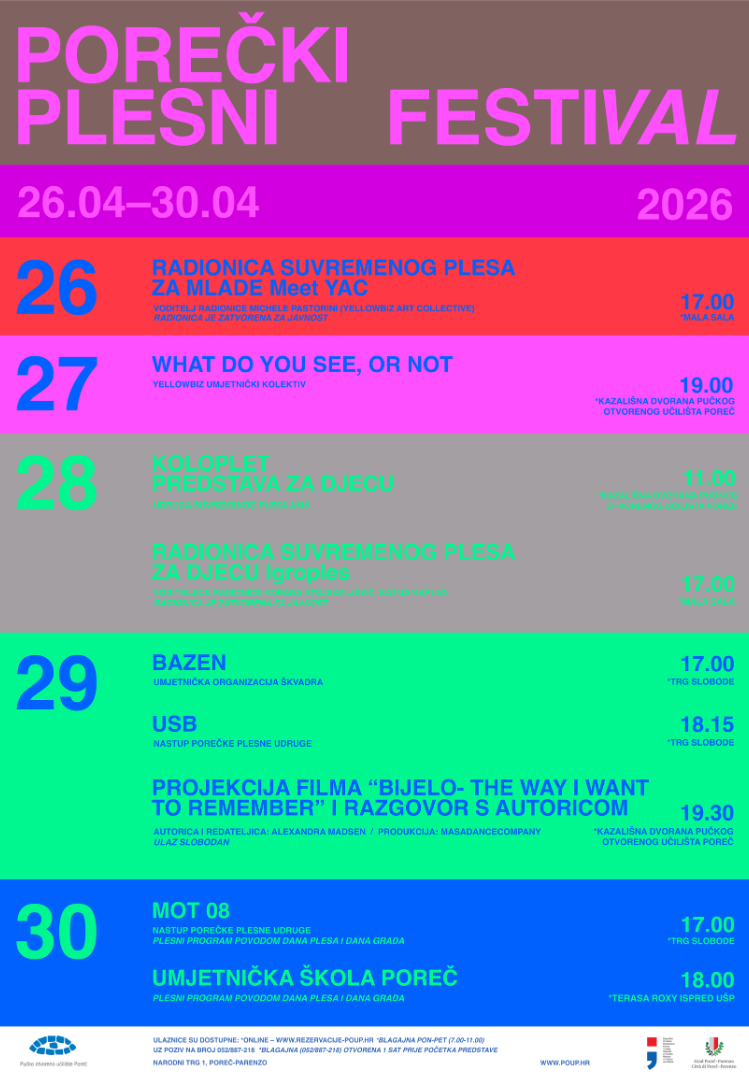
The Poreč Dance FestiVAL will take place from April 26 to April 30, 2026.
The festival is designed as a platform for presenting contemporary dance works, education through workshops, and exploration of the relationship between dance, space, and community. It brings together a wide audience—from the youngest participants to adults, including professional artists—and actively encourages citizens to take part in the cultural life of the city.
In the spirit of celebrating International Dance Day, Poreč becomes a meeting point for artists and audiences, a space for exchanging ideas, and a platform for exploring contemporary performance practices.
17:00 – Contemporary Dance Workshop for Youth “Meet YAC”
(Mala sala, Poreč Open University)
Led by Michele Pastorini (Yellowbiz Art Collective)
Closed to the public
19:00 – WHAT YOU SEE OR NOT
(Theatre Hall, Poreč Open University)
Yellowbiz Art Collective
11:00 – KOLOPLET (children’s performance)
(Theatre Hall, Poreč Open University)
Axis Contemporary Dance Association
17:00 – Contemporary Dance Workshop for Children “Igroples”
(Mala sala, Poreč Open University)
Led by Korana Stojsavljević and Katija Kaplan
Closed to the public
17:00 – BAZEN (The Pool)
(Trg Slobode – Freedom Square)
Škvadra Art Organization
18:15 – USB – Performance by the Poreč Dance Association
(Trg Slobode)
19:30 – Film Screening: Bijelo – The Way I Want to Remember + artist talk
(Theatre Hall, Poreč Open University)
Author & director: Alexandra Madsen
Production: MASADANCECOMPANY
Free admission
17:00 – MOT 08 – Performance by the Poreč Dance Association
(Trg Slobode)
Dance program marking International Dance Day and Poreč City Day
18:00 – Poreč Art School Performance
(Terrace of Roxy Bar)
Dance program marking International Dance Day and Poreč City Day
|
Poreč Dance Festi/VAL reflects on dance as a space of encounter: between body and city, between performer and audience, between experience and interpretation. Taking place during the celebration of International Dance Day, the festival does not present dance as a closed artistic form, but as an open system of relations—an ever-evolving medium shaped by the context in which it is created and performed.
The program unfolds through three guiding lines: the body as experience, space as partner, and the audience as an active participant. Through performances, workshops, film screenings, and discursive formats, dance is not offered as a finished product, but as a process—shared, tested, and continually redefined in relation to others. A significant layer of the festival is the inclusion of the local dance community—clubs, associations, and educational programs, including the dance school—creating continuity between the professional scene and the city’s everyday dance practice. With participants such as USB, MOT 08, and the Poreč Art School, the festival establishes itself as a shared space where different levels of experience and generations meet. The opening day focuses on perception and interpretation. The performance What do you see, or not by the Yellowbiz Art Collective raises the question: what do we actually see when we watch dance? In a time of accelerated meanings, the work destabilizes interpretative certainty and opens space for multiple readings. Dance appears as a field of uncertainty—yet it is precisely within that uncertainty that its precision emerges. The accompanying workshops further open the process, enabling the transfer of methodologies and embodied understanding of creation. The second day turns toward the youngest audience with Koloplet, produced by the Axis Contemporary Dance Association, exploring how our relationship with movement and the body is formed at an early age. Its interactive approach does not merely introduce children to watching dance, but to activating it through experience—movement as a tool for understanding the world. The workshops deepen this relationship, allowing children to explore through their own bodies what they have seen on stage. The third day moves the festival out of the theatre and into the city. The site-specific performance BAZEN by the Škvadra Art Organization activates urban space as a carrier of meaning, reminding us that places of gathering, play, and community are also political and emotional spaces. Dance here becomes not just performance, but an act of presence within a space that is constantly changing and disappearing. The involvement of local performers and the community further emphasizes shared experience and collective presence. The screening of the dance film Bijelo – The Way I Want to Remember expands the festival beyond physical performance into another medium. The film does not document dance—it transforms it. The camera becomes a choreographic tool, the frame a performance space, and editing a form of dramaturgy. Dance thus confirms its ability to exist beyond theatrical infrastructure while maintaining its artistic autonomy. A discursive program on the relationship between contemporary dance and local identity introduces a reflective layer, questioning how heritage is not preserved only through archiving, but through reinterpretation. Dance here becomes a medium that does not reproduce heritage, but activates, translates, and reimagines it. The Poreč Dance Festi/VAL does not attempt to offer a single image of dance. On the contrary, its curatorial framework insists on plurality of approaches, openness of process, and difference as a productive value. The festival builds a space in which dance is not only an artistic event, but a way of thinking, a way of being, and a way of relating to the world. Text written by the Festival selector, Alexandra Madsen. |