
Theatre
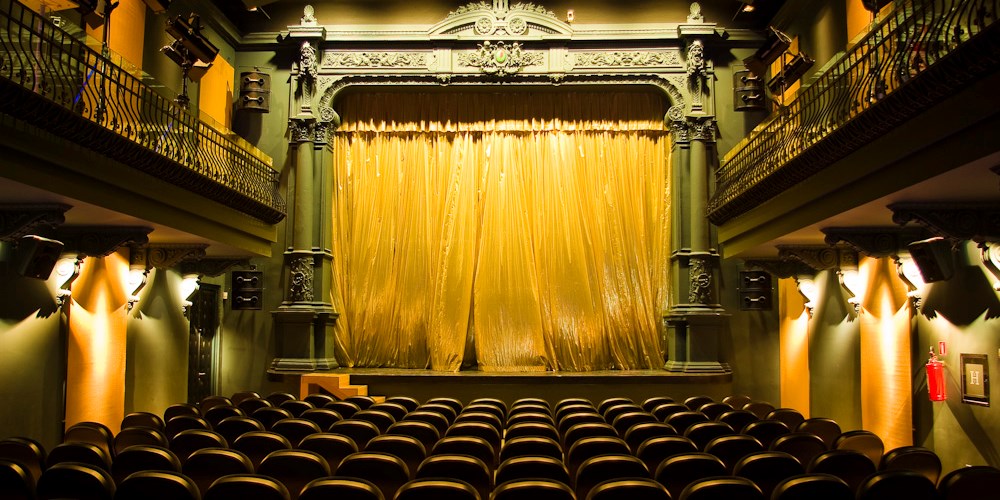
The Poreč theatre opened its doors on 10 December 1887 under the name Teatro Comunale (Municipal Theatre), and in 1901, after the death of composer Giuseppe Verdi, it was renamed Teatro Comunale Verdi – Parenzo. The building would carry the name Verdi until the end of the Second World War.
The Verdi Theatre was built according to the design of Trieste architect Domenico Pulghèr (1837–1917). The main façade has an almost perfectly square shape. Vertically, it is divided into three parts, with two narrower side projections that give the façade a sense of monumentality, their corners accentuated with rusticated stonework and featuring only a single narrow window in the lower section. These side sections form a strong contrast to the central part of the façade, which is completely open with large glazed surfaces and emphasized by the vertical line of the central cornice separating the ground floor from the upper floor.
On the ground floor, the central section is articulated by three large arched openings supported by massive rectangular pillars. The upper floor has an even stronger impression of lightness, with elegant Corinthian columns and large rectangular window openings decorated with ornamental wrought-iron railings at the bottom. The upper part of the façade is finished with a classical architrave, particularly prominent on the side sections. Above it, in the central part, stands a sculpture of the muse with two putti holding theatre masks.
The Poreč theatre has been modified several times—extended, restored, and technically reconstructed. On the right side, an extension was added, which initially differed stylistically from the original façade, with even more pronounced eclectic elements. Today it is architecturally integrated into the main façade. In 1902 the theatre was fully illuminated with chandeliers and safety lights, in 1907 gas was installed, and in 1910 electric lighting was added. The Verdi Theatre was renovated and reopened on 19 November 1910. At that time, sanitation facilities were improved and the entrance staircase was widened along the entire width of the façade and fitted with white stone balustrades. No major interventions were made until 2006, when the building underwent complete restoration.
Today, the auditorium holds 227 seats. In addition to theatre and cinema programmes, the venue is also available for various programme needs of city associations, public institutions, and other interested users.
Until the end of the Second World War, the theatre hosted visiting drama companies and amateur theatre groups from larger nearby cities such as Pula and Trieste, while Poreč’s own drama amateurs also performed their plays. Although the Poreč theatre as an institution was officially registered to host drama performances, operas and operettas, it also served as an important venue for musical concerts. Italian composers dominated the repertoire, and the main performers were usually Italian artists. Numerous themed lectures by local and international speakers were also held there. During the carnival season, dances—often masked—were organised. The theatre hall was likewise used by various city associations for their assemblies and meetings. From 1910 onwards, film screenings were also shown in the theatre.
After the Second World War, cultural events in the city were offered by Cinema Zagreb, whose activities expanded into cultural and educational programming. On 1 January 1960, the cultural institution Narodno sveučilište (People’s University) was officially established. Under its later name—Poreč Public Open University—it continues to operate here today.
The theatre hall remains a vibrant centre of community cultural life, hosting theatre performances, film screenings, concerts, events, presentations, and various special programmes throughout the year.